
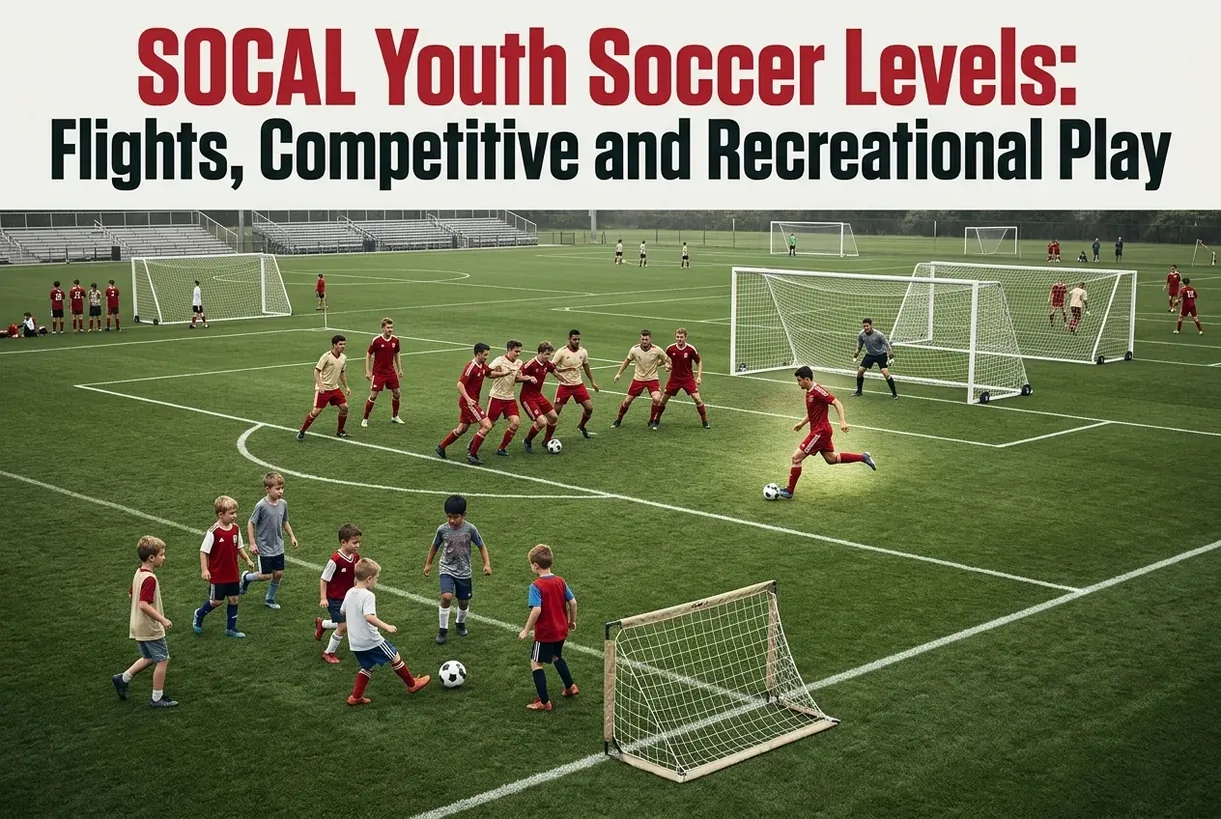
In the United States, youth soccer league levels range from local programs to national competitions. SOCAL Soccer assigns teams to flights, each representing a tier. Players usually begin in open-registration recreation programs, where coaches hold mandatory tryouts for each age group before forming rosters. Advancement proceeds from recreation programs to Flight 4, then up through Flight 3, Flight 2, and Flight 1. Some players focused on development may progress to National 1, ECNL, Girls Academy, or MLS NEXT. Playing time differs by level: coaches in recreational programs ensure all players rotate onto the field, while in flights, playing time depends on performance. As players move to higher tiers, families should expect increased travel.
Recreational And Competitive Soccer Overview
Recreational and competitive youth soccer differ in their approaches, so parents and players should understand these distinctions. Knowing what separates the two helps families choose the option that best fits the player’s skills, schedule, and goals, ensuring the player is placed in the most suitable group from the beginning.
| Factor | Recreational | Competitive Club |
|---|---|---|
| Entry process | Open registration | Tryout required |
| Annual cost | Low registration fee | Often $2,500+ |
| Travel range | Local matches only | Regional or statewide |
| Coaching type | Volunteer parent coach | Licensed professional coach |
| Playing time approach | Guaranteed 50 percent | Performance-based rotation |
| Tournament use | Limited or optional | Standard season requirement |
Entry Level Youth Soccer Programs
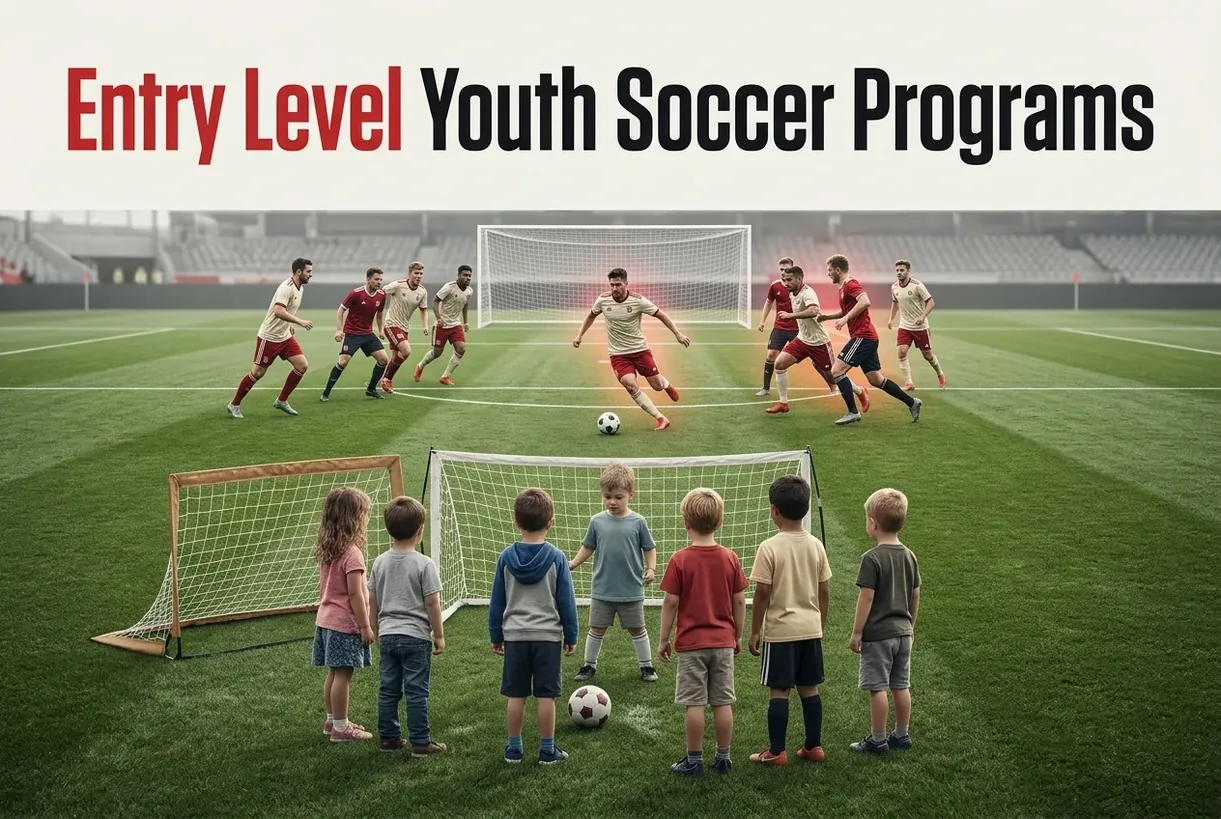
Many children in Southern California begin organized soccer through AYSO Core, AYSO EXTRA, or local club recreational and pre-club groups. In these local club pre-club groups, coaches use games and drills to teach skills. Children practice passing, learn their positions, and become familiar with the rules. Registration is required for AYSO and other leagues in the region. Volunteer coaches lead each group. League organizers establish a minimum playing time for all players. AYSO EXTRA requires tryouts, and players who are interested in more competition within AYSO can join after completing the tryout process.
Entry-level programs are available in several formats. Each format has unique features, which participants should review beforehand.
- AYSO Core serves players ages 6U through 19U;
- EXTRA offers tryouts for stronger play;
- Pre-club technical clinics are available;
- Clubs run weekly structured practices;
- Matches take place locally on weekends.
SOCAL Flight Structure Overview
SOCAL assigns every team to one of four flights: Flight 4, Flight 3, Flight 2, or Flight 1. Staff determine each placement by considering results, team strength, and scheduling needs. Teams may shift to a different flight between seasons. The steps below explain how this structure operates:
- Review Flight 4 – identify it as the entry-level competitive tier;
- Examine Flight 3 – recognize it as locally focused competitive play;
- Assess Flight 2 – treat it as an intermediate regional level;
- Evaluate Flight 1 – confirm it as the highest standard within the SOCAL structure.
Key Differences Between SOCAL Flights
SOCAL flights follow distinct formats. Flight 1 requires players to make decisions while moving the ball and maintaining team shape. In Flight 2, the team structure stays the same for every game, though individual player performance can vary. Flight 3 centers on matches, with the skill level of each team in this flight subject to change. Coaches substitute players according to age-group rules that apply to each flight. Families should confirm these formats with the club.
These flights vary in several respects.
| Aspect | Flight 1 | Flight 2 | Flight 3 |
|---|---|---|---|
| Pace | Fast and demanding | Moderate to fast | Developing and variable |
| Tactical demand | High positional structure | Consistent team shape | Foundational organization |
| Physical intensity | High | Moderate to high | Moderate |
| Typical player profile | Advanced regional competitor | Established club participant | Developing club participant |
| Geography | Regional home-and-away | Broad regional scheduling | City or county scheduling |
| Common goals | N1 and national access | Regional advancement | Flight 2 or Flight 1 movement |
SOCAL National 1 Competition Details
The National 1 division operates under a new structure. This update affects SOCAL teams. The following information outlines the details for the National 1 division.
- National 1 serves age groups U13 through U19;
- Teams complete regional and national travel;
- Postseason national finals are part of the seasonal structure;
- College recruiting exposure is a standard feature;
- The program carries a high seasonal commitment.
Elite National Youth Soccer Pathways
Commitment leagues allow players ages U13 to U19 to participate in organized national competitions. Clubs coordinate these events through the ECNL, ECNL Regional League, Girls Academy, and MLS NEXT.
Players in the ECNL, MLS NEXT, and Girls Academy receive instruction and travel nationwide according to set schedules. College recruiting programs connect directly with players in these leagues. The ECNL Regional League serves as a regional entry point for players, who can progress into ECNL competition.
| Category | ECNL | Girls Academy | MLS NEXT | ECNL Regional League |
|---|---|---|---|---|
| Gender | Boys and girls | Girls only | Boys only | Boys and girls |
| Travel scope | Regional and national | National | National | Regional postseason travel |
| Age focus | U13 to U19 | U13 to U19 | U13 to U19 | U13 to U19 |
| Main goals | College recruiting elite play | Elite girls development | Pre-professional boys path | Regional advancement ECNL entry |
| Typical club type | Established elite clubs | National affiliate clubs | MLS-connected academies | Competitive regional clubs |
How Families Select Soccer Levels
Choosing the appropriate soccer level for a child requires careful planning, as each tier of soccer places unique demands on players and families. Parents should approach each decision thoughtfully. Recreational programs, SOCAL flights, and national competitions vary in playing time, coaching quality, roster size, and annual expenses. Families must consider weekly travel time and the player’s motivation as these factors shift with increasing levels.
Step-by-step instructions outline key criteria. Families rely on this information to narrow their options and make selections.
- Discuss the player’s goals directly and honestly.
- Assess current technical ability against available team standards.
- Compare expected playing time across candidate programs;
- Calculate full annual costs including tournaments and travel.
- Estimate weekly driving time for each option.
- Confirm coaching licenses and session frequency.
- Review roster size and substitution formats.
- Weigh school schedules against travel requirements.
Understanding SOCAL Soccer Progression
The structure consists of open recreational programs, SOCAL’s tiered flights, National 1, and elite national competitions. Placement is determined by consistent participation, technical growth, and enthusiasm, rather than by division name. Players in lower flights who train regularly with a coach achieve better long-term outcomes than those who rarely participate. At the end of each season, families should review club fit, playing time, travel demands, and costs. Placement adjustments should match the player’s current readiness and goals.
FAQ
What Is The Difference Between Recreational And Club Soccer?
Recreational soccer uses open registration to welcome new players, and organizers form balanced teams to ensure fairness. Matches take place locally, which reduces annual costs for families. Club soccer requires tryouts and licensed coaches. Families involved in club soccer travel more, and the system does not guarantee set playing time per match.
How Are SOCAL Soccer League Flights Organized From Lowest To Highest?
SOCAL assigns teams to flights numbered 4 to 1. Higher numbered flights face stronger opposition and have wider geographic schedules. Teams are placed in flights each season and may move between flights based on results.
What Are SOCAL National 1 And NPL Divisions?
Starting in the 2026–27 season, National 1 will replace the former NPL and feature teams in the U13 to U19 age groups above the flights. Qualifying teams can participate in postseason events, including showcases and finals held outside Southern California.
Which Players Should Consider ECNL, Girls Academy, Or MLS NEXT?
To join ECNL, Girls Academy, or MLS NEXT, players must demonstrate technical skill. Consistent commitment in every training session is required. Players benefit from setting a college or pre-professional goal, as it helps them maintain focus while progressing. Attention to travel plans is also necessary. Coaches at these levels award roster spots or promotions to those who meet these expectations.