
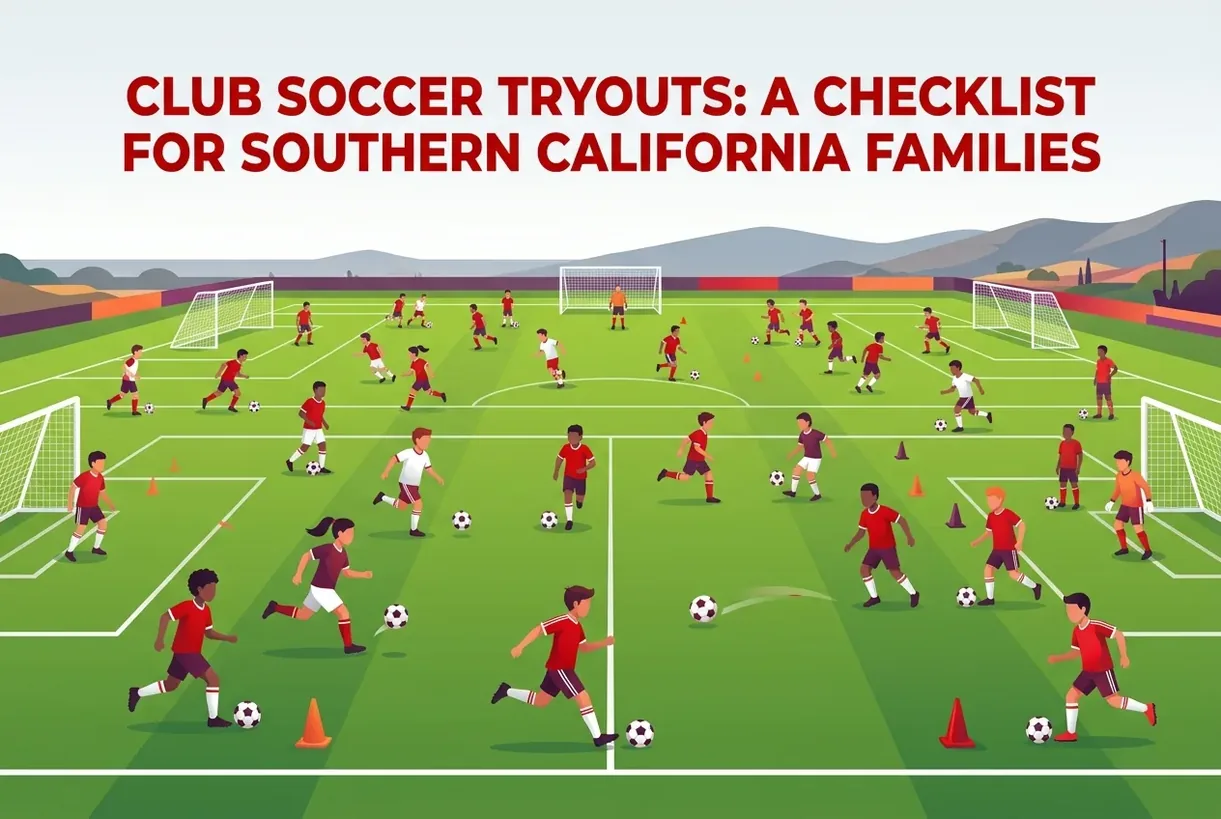
Clubs organize club soccer tryouts in various ways to select players for roster spots and assess player development. During drills and games, staff observe players’ skills, decision-making, movement, and communication. Schedules, registration steps, and costs differ by club. Families should review details in advance to compare options.
Southern California Tryout Timing
Clubs in Southern California choose evaluation dates at different times, so families can look up these dates to compare their choices. This gives families more time to prepare registration materials without rushing.
| Timing Aspect | Details |
|---|---|
| Younger age windows | January through March |
| Older age months | February through April |
| Secondary evaluation periods | May or June openings |
| ID camp timing | Spring, pre-formal tryout |
| Open training timing | Flexible, club-scheduled |
| Registration cutoffs | A few days ahead of the session |
| Notification expectations | Within two weeks post-evaluation |
| Rainout reschedule plans | Club-issued backup date |
| Evening session patterns | Weeknights, 5–8 PM |
| Weekend session patterns | Saturday or Sunday morning |
How Players Prepare Physically

Youth soccer players benefit from three to four weeks of technical practice before tryouts, focusing on ball mastery, passing, and first-touch drills. Coaches add 10- to 20-meter sprints to build acceleration for quick position changes while avoiding excessive fatigue. Players should stay hydrated, eat regular meals, and get eight hours of sleep nightly, as these habits support concentration and readiness for training. Sticking to a plan in the weeks before evaluation day helps players feel prepared and confident.
- Start technical sessions. Begin ball mastery and passing work 4 weeks out.
- Add sprint sets. Run 10–20 meter acceleration repetitions 3 weeks out.
- Sharpen first touch. Focus every receiving repetition on clean control 2 weeks out.
- Practice scanning. Look over the shoulder prior to every pass during all sessions.
- Reduce volume. Cut training intensity by 30 percent one week ahead of the evaluation.
- Complete light work. Do 20 minutes of ball touches and mobility 2 days prior.
- Pack equipment. Lay out cleats, shin guards, socks, and a filled water bottle the evening prior.
- Arrive early. Reach the evaluation location 20 minutes ahead of the scheduled start.
Essential Gear And Documents
Before soccer tryouts, families should review what players need. Start with a checklist. Players must bring cleats and shin guards. A shirt or pinnie is required. Extra layers are helpful if the weather shifts. Pack a water bottle. Many clubs require online registration or medical release forms.
- Cleats suited to the field surface;
- Shin guards worn under soccer socks;
- Numbered shirt or issued pinnie;
- Weather-appropriate training layers;
- Filled water bottle;
- Online registration confirmation;
- Completed medical release forms;
- Player identification details;
- Emergency contact information;
- Extra socks and a spare shirt.
On Field Evaluation Priorities
Soccer coaches pay attention to first touch and ball control. They notice whether players scan the field before receiving the ball. Coaches observe how players move when they do not have possession. They listen to the way teammates communicate during play. At every stage, coaches assess skill, decision-making, ability, and behavior. What players do is more important than the outcome of a play. Coaches also notice which players remain involved throughout scrimmages.
- First touch under pressure;
- Accurate short passing;
- Ball control in tight areas;
- Active scanning prior to receiving;
- Quick decision after possession;
- Movement away from the ball;
- Defensive transition speed;
- Communication with teammates;
- Composure following errors;
- Willingness to compete and effort across all activities.
League Levels In Southern California
Southern California clubs fall into tiers. Understanding the differences between each tier helps families focus their search. The club match depends on a player’s skill level, growth plans, and how much travel and commitment the family can manage.
| Tier Name | Competition Level | Typical Travel Range | Player Profile |
|---|---|---|---|
| SOCAL Flight 1 | Highest local tier | Regional cross-county travel | Advanced competitive player |
| SOCAL Flight 2 | Strong competitive level | Multi-county travel | Established competitive player |
| SOCAL Flight 3 | Local competitive level | City or county only | Developing competitive player |
| NPL | High regional competition | Broad regional travel | Ambitious advanced player |
| ECNL-RL | Regional elite competition | Regional showcase travel | High-level developing player |
| ECNL | Elite national competition | Extensive national travel | Top-level committed player |
| MLS NEXT | Elite academy-track tier | National and regional travel | Advanced academy-bound player |
Key Questions For Club Coaches
Before accepting an offer, parents should ask the club soccer coach questions. They need to request written details from several clubs for comparison. While coaches may make promises, families should ensure all information is provided in writing. Later, review every detail. Confirm the roster size. Inquire about playing time, the training schedule, the match calendar, and planned tournaments. Ask how far the team travels and request the yearly cost in US dollars.
- Playing time philosophy;
- Typical roster size;
- Weekly training frequency;
- Match and game calendar;
- Planned tournaments;
- Travel distances and overnight requirements;
- Total annual fees in USD;
- Separately billed uniform costs;
- Supplemental training expectations;
- Acceptance deadline details.
Steps After Receiving An Offer
Soccer clubs share tryout results and team offers through email, phone calls, or direct messages from the coach. When a decision is available, the club lets families know. Families then have 48 to 72 hours to respond to the offer. Before a spot is confirmed, parents register in GotSport or another system, submit the necessary documents, select the age group, and pay the required fees.
Complete each step in sequence. Submit an offer, then proceed through every stage. At the conclusion, receive roster status.
- Receive the offer. Obtain the written roster decision from the club.
- Review the details. Read the team placement, deadline, and fee structure.
- Ask outstanding questions. Contact the coach prior to submitting any acc.
- Open GotSport. Log in and locate the player’s profile.
- Upload documents. Attach all forms the registrar requests.
- Submit payment. Complete all required fee transactions in the system.
- Confirm roster status. Check with the registrar that the player appears on the official roster.
Choosing The Right Environment
Families select clubs, and this decision influences how a player develops over time. In Southern California, understanding the league flight levels is important. Training demands, annual costs, and travel distances all factor into the choice. When families review the calendar, they find details that guide where to place the player. They also consider information from registration timelines, evaluation criteria, league structure, and roster deadlines. Parents can speak with coaches to learn more. This process helps them identify clubs that match a player’s abilities and goals. By following these steps, families choose a club in Southern California that fits their needs now and supports the player’s continued growth.
FAQ
Southern California Tryout Timing
Most Southern California clubs hold main assessments from February to April, with some offering additional sessions in May or June if roster spots remain.
What Should Players Bring To Tryouts?
Bring a water bottle to the session. Players should wear cleats, shin guards, soccer socks, and weather-appropriate clothing. Keep your registration confirmation with you. Have your medical release forms ready.
SOCAL Flight Level Differences
The SOCAL competition includes three flights. In Flight 1, teams from the region compete against each other. Flight 2 focuses on a certain level of play, and teams travel between counties for their matches. Flight 3 offers games designed for players who are developing their skills.
Time Allowed To Accept Offers?
Each club chooses its own offer deadline, which appears on the written offer. Families need to pay attention to this date and reply before the deadline to keep the roster spot.